অনুগ্রহ করে অপেক্ষা করুন। ছবি আটো ইন্সার্ট হবে।





war criminal''
Dear readers,
As we all know that Jamaat-e-Islami which is now known as
Jamaat-e-Islami Bangladesh was heavily drawn into mass murdering,
rape, arson, looting and especially killing of intellectual during the
last part of our glorious liberation war. Jamaat or Jamatis was
related with most genocide that happened during nine months of
liberation war. To understand the genocide of 1971 and those who
committed the genocide we must recognize and identify Jamaat leaders
and their heinous activities during 1971 as well as their conspiracy
against the democratic secular Bangladesh at this time.
Most of the Jamaat leaders of today's Jamaat-e-Islami Bangladesh have
a very dark chapter of their life which they try to hide by all means.
Their heinous activities in the name of Allah and Islam they committed
and continue to commit crime against humanity must be challenged. They
were danger then and more dangerous now. Their treacherous activity is
challenging for true democratization of our country where pluralistic
society will thrive.
Jamaat-e-Islami who completely disagree with the basic premise of
democratic pluralistic state and society by participation of all
citizens with equal right and wants to establish Moulana Moududi
version of Islam by any means.
Deceiving, lying and conniving manipulation of two faces
Jamaat-e-Islam is in sequence with the teaching of their spiritual
guide and founding father Syed Ab'ul Ala Maududi. In page 54 of his
Voluminous "Tarjamanul Qura'an": - he said "Truth is one of the most
important principles of Islam and lying is one of the greatest sins.
But in real life some needs are such that telling a lie is not only
allowed, in some circumstances it is decreed mandatory".
Dear readers, to uncover or revisit the truth, to understand the depth
of Jamaat-e-Islam's conspiracy against our democratic institution we
have taken this step to bring Jamatis out of there closet and
introduce them to our new generation.
We must understand the true enemy of pluralistic democratic Bangladesh
is NONE BUT PAROCHIAL JAMAAT-E-ISLAM of Bangladesh.
I urge you to speak out against this vicious political identity and
help our new generation to understand them better. Please contribute!
We start our second part of this series "Jamaat-e-Islam Bangladesh:
Profile of a killers" series with Golam Azam the first Amber of
Jamaat-e-Islam Bangladesh" aiming to expose these heinous killers and
continue to uncover all other executive members of Jamaat-e-Islam
Bangladesh.
Central Executive Committee
* Maulana Motiur Rahman Nizami
Amber-e-Jamaat & President,
1. Maulana Abul Katam Muhammad Yusuf
2. Mr. Maqbul Ahmad
3. Prof. A.K.M. Nazir Ahmad
4. Ali Ahsan Mohammad Mojaheed
5. Maulana Abdus Sobhan
6. Maulana Delawar Hossain Sayedee
7. Mr. Muhammad Kamaruzzaman
8. Mr. Abdul Quader Molla
9. Mr. ATM Azharul Islam
10. Mr. Badre Alam
11. Mr. Abu Naser Muhammad Abduzzaher
12. Mr. Mir Kasem Ali
13. Maulana Rafiuddin Ahmad.
14. Barrister Abdur Razzak.
15.Moulana Rafiqul Islam Khan
Member Central Working Committee
* Maulana Motiur Rahman Nizami : Amber-e-Jamaat
1 Maulana Abul Kalam Muhammad Yusuf : Senior Nayeb-e-Ameer
2. Mr. Maqbul Ahmad : Nayeb-e-Ameer
3. Prof. AKM Nazir Ahmad : Nayeb-e-Ameer
4. Mr. Ali Ahsan Mohammad Mojaheed: Secretary General
6. Maulana Abdus Sobhan : Central Executive & working Committee
Member
7. Maulana Delawar Hossain Sayedee : Central Executive & Working
Committee Member
8 Mr Muhammad Kamaruzzaman : Senior Assistant Secretary General
9. Mr. Abdul QuaderMolla : Assistant Secretary General
10 Mr ATM Azharul Islam : Assistant Secretary General
11 Prof. Mujibur Rahman Assistant Secretary General
12. Maulana MuharnmadAbuTaher: Assistant Secretary General
13 Mr.BadreAlarn Central Executive Working Committee Member
14 Mr Abu Naser Muhammad Abduzzaher Working Committee member
15.Mr. Mir Kasem Ali : Central Executive & Working Committee Member
16. Maulana Rafiuddin Ahmad : Member
17. Barrister Abdur Razzak: Assistant Secretary General
18. Principal Ahdur Rob: Central Working Committee Member
19. Maulana Sarthr Abdus Salam: Central Working Committee Member
20. Prof. Md.TasneemAlam: Central Working Committee Member
21. Mr. Abul Asad: Central Working Committee Member
22. Prof. Sharif Hossain Central Working Committee Member
23. Maulana Nazrul Islam Advocate: Central Wo Committee Member
24. Mr. Ataur Rahman : Central Working Committee Member,
Rajshahi City
25. Dr. Muhammad Shafiqur Rahman : Central Working Committee
Member, Syihet City
26. Principal Shah MuhcL Ruhul Quddus : Central Working
Committee Member
27. Maulana Mominul Haq Chowdhuiy: Central Working Committee Member
28.Dr.AnisurRahman : Central Working Comrnittee Member
29. Prof. Fazlur Rahman : Central Working Committee Member
30. Mr. Muhammad Shahed : Central Working Committee Member
31. Maulana Farid Uddin Chowdhury: Central Working Committee Member
32. Mr. Golam Rabbani: Central Working uittee Member
33. Mr. Saiful Alam Khan Milon : Central Working Committee Member
34. Mr. Abdur Rob : Central Working Committee Member
35. Prof. Mian Golam Parwar : Central Working Committee Member,
Khulna City
36. Advocate Abdul Iatif : Central Working Committee Member
37. Principal Muhammad Izzatullah : Central Working Committee Member
39. Mr. Mominul Islam Patwary : Central Working Committee Member,
39. Maulana Shamsul Islam : Central Working Committee Member,
Chittagong_City
40. Advocate Moazzem Hossain Helal : Central Working Committee
Member, Barisal City
Jamaat-e-Islam Bangladesh: Profile of killers Golam Azam First
Amber-e-Jamaat of Bangladesh
The head (Ameer) of the collaborators (Rajakar) of Pakistani
occupation army and a heinous war criminal. The vile monster behind
the genocide of 1971, rapes and molestation of 45,00,000 Bengali women
and murder of hundreds of pro Bangladesh intellectuals. In one of the
photos recovered from the archive of Pakistan military intelligence
Golam Azam and his top associate Motiur Rahman Nizami are seen handing
the list of the names of progressive Bangalee intellectuals over to
the Pakistani generals for elimination. The guru of extremist Islamic
ideologies in Bangladesh. The leader of 70,000 Razakars, Al-Badr and
Al-Sams forces.
(New York Times, 30 July, 1971).
War criminal Golam Azam cartoon link:
http://www.iftwcb.org/images/ghatak.jpg
When the burden of the killing became too much for the army, the
Pakistanis enlisted and trained paramilitary units made up of
non-Bengali Muslims and Bengali collaborators from right-wing
religious parties. These paramilitary units, the al-Badr and al-Shams,
worked as informers and assassins to augment the military's gruesome
task of killing Bengalis. In June 1971 Sydney Schanberg reported on
the formation of these units:
In June 1971 Sydney Schanberg reported 'Throughout East Pakistan the
Army is training new paramilitary home guards or simply arming "loyal"
civilians, some of whom are formed into peace committees. Besides
Biharis and other non-Bengali, Urdu-speaking Moslems, the recruits
include the small minority of Bengali Moslems who have long supported
the army -- adherents of the right-wing religious parties such as the
Moslem League and Jamaat-e-Islami led by Golam Azam and Motiur Rahman
Nizami
These groups collectively known as the Razakars, the paramilitary
units spread terror throughout the Bengali population. With their
local knowledge, the Razakars were an invaluable tool in the Pakistani
Army's arsenal of genocide.'
However, In June the Pulitzer Prize-winning journalist Sydney
Schanberg filed a number of eyewitness accounts from Bangladeshi towns
for The New York Times. In response, the Pakistan army expelled him
from the country on June 30, 1971.
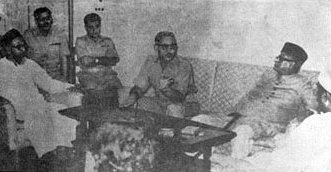
Photo link: http://www.iftwcb.org/images/gomet.jpg
Golam Azam, Rao Forman & Malek, discussing blue print for killing the
pro Bangladesh intellectuals
The Pakistan army, on the verge of defeat, was determined to wipe out
Bengali culture in one final act of barbarism. On December 14, 1971,
the Pakistan army unleashed the paramilitary units led by
Jamaat-e-Islami Al-Badr and Al-Shams to exterminate Bengali
intellectuals. The goal was to find and kill Bengali political
thinkers, educators, scientists, poets, doctors, lawyers, journalists
and other intellectuals. The al-Badr and al-Shams fanned out with
lists of names to find and execute the core of Bengali intellectuals.
The intellectuals were arrested and taken to Rayerbazar, a marshy area
in Dhaka city.
There, they were gunned down with their eyes blindfolded and their
hands tied behind their backs. Jamaat-e-Islami and its leaders were in
the forefront of this planning and execution of Bengali intellectuals.
Al-Badr and Al-Shams systematically executed well over 200 of East
Pakistan's intellectuals and scholars. Professors, journalists,
doctors, artists, engineers, writers were rounded up, blindfolded,
taken to torture cells in Mirpur, Mohammadpur, Nakhalpara, Rajarbagh
and other locations in different sections of the city; and executed en
masse in the killing fields, most notably at Rayerbazar and Mirpur.
Several noted intellectuals who were killed from the time period of
25th March to 16th December, 1971 in different parts of the country
include Dr. G. C. Dev (Philosopher, Professor at DU),Dr. Munir
Chowdhury (Litterateur, Dramatist, Professor at DU), Dr. Mofazzal
Haider Chowdhury (Litterateur, Professor at DU), Dr. Anawar Pasha
(Litterateur, Professor at DU), Dr. Fazle Rabbi (cardiologist), Dr.
Alim Chowdhury (opthalmologist), Shahidullah Kaisar (journalist),
Nizamuddin Ahmed (Reporter), Selina Parvin (reporter), Altaf Mahmud
(lyricist and musician), Dr. Hobibur Rahman (mathematician, Professor
at RU), Dhiren Dutt (politician), R. P. Saha (philanthropist), Lt.
Col. Moazzem Hossain (ex-soldier), Mamun Mahmood (Police Officer)and
many others.
Noted writter Dr. Rashid Aksari stated in one of his writing "The
paramilitary force Al-Badr, which was formed in September 1971 under
the auspices of General Niazi, chief of the Eastern Command of the
Pakistan Army, was the instigator of that hideous massacre. Their
objective was to strike panic into the people by abduction and
killing. It was the military adviser to the so-called Governor, Major
General Rao Forman Ali who masterminded the whole conspiracy to
extinguish the intellectuals and the higher educated class. Had they
had one week time more, they would have killed all the Bengali
intellectuals, which was a part of their master plan. The Badr force
was in fact a special terrorist faction of the then Jamaat-e-Islami
led by Moududi, Golam Azam, and Abdur Rahim.
He continues to narrate "Immediately after submitting the killing
plan, Golam Azam, along with the chief of the Razakars, Mohammad
Yunus, and the liaison officer of the Peace Committee, Mahbubur Rahman
Gurha, went to see the training of the Razakar and Al-Badr at the
Physical Training College. From then on the Student Sangha all over
the country was transformed into Al-Badr and in the last week of
November and first half of December the list of the intellectuals was
handed over to them for abduction and persecution.
On December 4 began the imposed curfew and black out to pave the way
for abduction. The preparation for abduction of the intellectuals
extensively started from December 10. Amid curfew and black out, an
Al-Badr bus, stained with mud, picked up the listed intellectuals from
their residences. Then they were taken to the Al-Badr headquarter at
Mohammadpur Physical Training College for interrogation and
persecution. At dead of night they were taken to Rayerbazar brick
field and killed. The killing also took place at Mirpur.
Golam Azam (born 1922) the mother of all killer, is a Bangladeshi
political leader. He is also widely known as a war criminal who
collaborated with the Pakistan Army during the Bangladesh Liberation
War of 1971, particularly with regards to creating and managing the
vigilante Razakar and Al-Badr forces. Recently released unclassified
documents of the Pakistan government reiterate his role as a war
criminal. He refused to accept the independence of Bangladesh upon its
liberation on December 16th 1971, and was a permanent resident of
Pakistan until 1978, and maintained Pakistani citizenship until 1994.
Entering politics as a student leader at Dhaka University, Azam became
the secretary of the fundamentalist Jamaat-e-Islami Bangladesh in
1957. Later, he became the Amber (president) of the Jamaat in East
Pakistan in 1969. During the Bangladesh Liberation War of 1971, he was
accused of collaboration with the Pakistan Army, and was also accused
of war crimes.
To the last leg of nine months long war on receiving an urgent
telegram from Maududi, Golam Azam went to Lahore, on 22 November 1971,
to see him. He could not return to Bangladesh as his citizenship was
revoked by Sheikh Mujib government. Failing to return to Bangladesh
the arch criminal went to Mecca, ostensibly, for Hajj. From Saudi
Arabia Go Azam traveled Dubai, Abu Dhabi, Kuwait, Beirut and Libya to
lobby against Sheikh Mujib government and raise funds for counter
revolution.
Following his extensive international PR activities Go Azam arrived in
London. From London he published the Jamati newspaper Daily Sangram on
a weekly basis. In 1974, the weekly Bichitra published a very
interesting report on Golam Azam's activities in London: In early
1974, Golam Azam presented a blueprint of anti Bangladesh activities
at a committee meeting held in a house in East London. According to a
reliable source some Pakistani nationals were also present in that
meeting.
The participants in that secret meeting were: AT Sadi, Toaha bin
Habib, Ali Hossain, Barrister Akhtar Uddin, Meher Ali and Dr Talukdar.
Pakistani citizen Mahmud Ali is one of the top Pakistanis present in
that meeting. The chair of the meeting Golam Azam said " to continue
our activities from London will be difficult. So someone has to go
back home. We ought to take risk-otherwise there will be no outcome.
But if you go home-you will have contacts. I have already contacted my
people. Everything is okay. Handing out a leaflet to all members
present Golam said it has to be distributed among the people of every
village of Bangladesh. People are with us.
According to some sources the said leaflet contained propaganda for a
proposed confederation with Pakistan. Others believed that it called
for an Islamic revolution organized using the network of mosques. Some
people were reported to have arrested near Dhaka carrying those
leaflets. Golam Azam also mentioned the proposed support for anti
Bangladesh activities from Pakistan and some other Middle Eastern
countries. (Like Zia) Golam Azam said `Money is not a problem'.
It was heard that Golam Azam collected 45,000,000 Reals from Saudi
Arabia for reconstructing the mosques of Bangladesh demolished during
the war. Shrewd Golam spent a large portion of that money to purchase
a house in Manchester in UK. Presently his son Mehedi Hasan is living
in that house. Golam' eldest son Kaifi Azmi is a senior officer in
Bangladesh Army and believed to be working as a link between ISI cell
in Bangladesh Army and Jamati Terrorist groups.
After the war, the Bangladesh government sought to remove the
influence of the fundamentalists and collaborators, and Golam Azam's
citizenship was cancelled. He chose to live in exile in Pakistan and
England until 1978, when President Ziaur Rahman re-established
multi-party democracy and legalized the previously banned
fundamentalist parties, and allowed him to return to Bangladesh on a
temporary visa.
Golam Azam became the unofficial Amber of the party while remaining in
the country illegally (though no attempt was made to restrain him and
he moved around openly), and his citizenship was restored in 1994 by a
decision of the Supreme Court of Bangladesh.
Ghulam Azam announced his retirement from active politics in late
2000. He was succeeded by Motiur Rahman Nizami. Golam was Ameer of
Jamaat-e-Islami from 1969 to 2000 which is THIRTY ONE YEAR ( So called
Islamic Democracy) probably just to follow the foot step of his leader
Moududi who was also the ameer of Jamaat from its formation on 6
August 1941 till 1972 which is THIRTY ONE YEAR too.
Ghulam Azam's party, Jamaat-e-Islami, has been accused by a cross
section of political parties and secular organizations as a patron of
recently (2002-2006) rising militancy and behind a number of terrorist
bombings. Almost all of the recently arrested militants were alleged
to have links in the past to either the Jamaat or its student wing,
the Islami Chhatra Shibir some Bangladeshi newspapers such as The
Daily Star, Prothom Alo, Janakantha and Bhorer Kagoj describes Jamaat
as who favors destabilizations of mainstream politics so as to reap
the dividend from the subsequent vacuum.
Reference:
1. Liberation Museum
2. Killers and Collaborators of 1971: An Account of Their
Whereabouts, compiled and published by the Center for the Development
of the Spirit of the Liberation War
3. Commission on War Criminals of Bangladesh
4. Saiduzzaman Raushan: Speeches and Statements of Killers &
Collaborators of 1971
5. Our martyred intellectuals by Dr. Rashid Askari
6. West Pakistan Pursues Subjugation of Bengalis; West Pakistan
Pursues Bengali Subjugation by SYDNEY H. SCHANBERG
7. The portrait of Golam Azam by Dr Humayun Azad
8. Jahanara Imam: Ekatturer Dinguli
9. Jahanara Imam: Buker Vitor Agun
10. Sadiq Salik - Witness to Surrender
11. S M Shafiullah - Bangladesh At War
সর্বশেষ এডিট : ০৪ ঠা জুন, ২০০৭ দুপুর ২:৪৯